

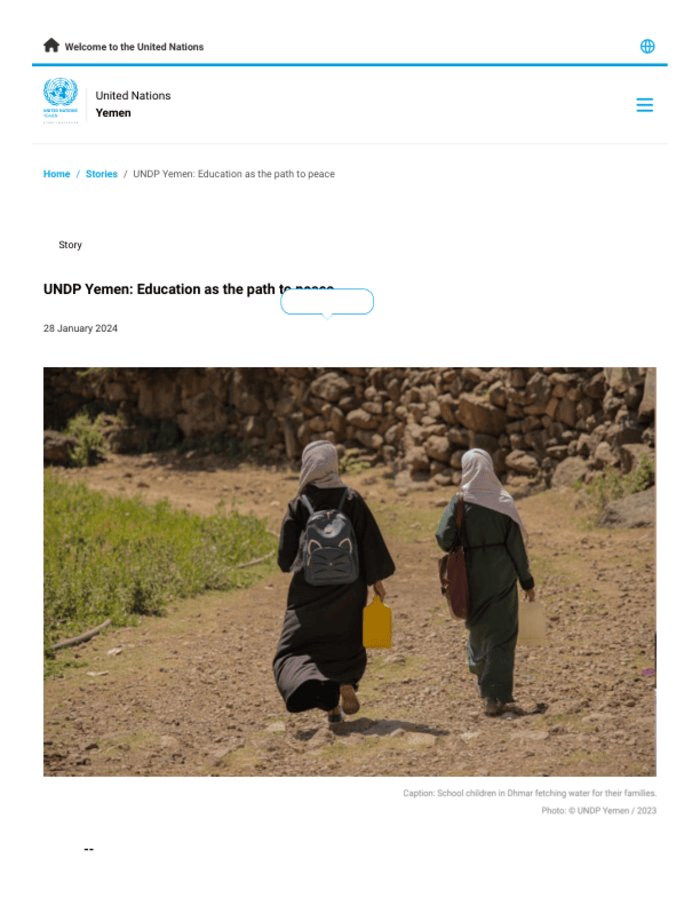
In 2018, the United Nations General Assembly proclaimed 24 January as International Day of Education, commemorating the role of education in peace and development. Education goes beyond the critical skills of reading, writing and numeracy, research has shown that it increases abilities such as empathy, tolerance and cross-cultural understanding. Education is a right, a public good and a public responsibility.
Education, in all its forms and dimensions, both inside and outside the classroom, can and should be a pathway to lasting peace in Yemen and beyond. Against a backdrop of rising tensions, widening inequalities and the climate crisis, prioritizing and investing in education is more attractive than ever.
As part of the first phase of the United Nations Peace Support Facility's intervention, school safety trainers were trained to improve the safety of more than 50,000 students in 50 schools in six Yemeni governorates.
Ensuring that educational spaces are safe havens for students and educators is critical to continuity of learning and education, the right to quality education, and the promotion of peace and social cohesion. .
In 2022, the United Nations Peace Support Facility will collaborate with the Women's Research and Training Center (WRTC) at Aden University to develop the skills of community members and equip them with mediation, dialogue, analytical thinking and negotiation skills. Established a peacebuilding network. Additionally, the network advocates the Women, Peace and Security (WPS) agenda and advocates for women's participation in peace processes in all sectors through university training, workshops and lectures.
The 100 men and women network members continue to actively pass on the knowledge and skills they have gained through the peacebuilding network to members of their local communities.
Dr. Saeed Al-Kashbri is an Associate Professor and Gender Analysis Consultant at WRTC, and Executive Director of WRTC's Feminist and Development Studies Master's Alumni Network.
With over 15 years of experience as an academic, Dr. Saeed believes that investing in peace education can accelerate progress towards peace in Yemen.
“Yemen's demographic diversity requires that the education system be recalibrated to develop capacities such as tolerance, social cohesion, cooperation, acceptance of others, and rejection of intolerance and extremism. ”
“If the education system becomes more gender-inclusive, more women will be able to reach decision-making positions. I will contribute.”
Dr. Huda Ali Allawi is a professor of criminal law at the Faculty of Law, a human rights and women's rights researcher, and a conflict resolution consultant. She is also the director of the Women's Research and Training Center at Aden University.
“No lasting peace can be achieved without education. Education contributes to the psychosocial and cognitive development of communities. It allows communities to learn skills such as mediation and to better shape people's behavior. We can change it for the better.”
“It is important to raise awareness, especially among children and young people, of the importance of conflict prevention and the link between achieving lasting peace and sustainable development, climate action and food security. Because it means more than just the absence of violence.”
Education offers learners a path to a promising future and a ladder out of poverty, but the latter is a major factor in conflict. It must be transformative and help equip learners with the knowledge, values, attitudes, skills and behaviors they need to become agents of peace.
These activities were made possible thanks to generous funding from the European Union, the German Cooperation Agency and the Norwegian Government.
