

Who ordered 2024 NBA trade deadline grades, with an extra heaping side of second-round pick protections?
Because we’ve got ’em.
No stars were moved, but important stuff still happened. And we’re about to cover it all. Every deal that was completed between Wednesday and the 3 p.m. ET Thursday deadline is graded in dedicated sections. Smaller, on-the-margins trades are looped together at the end.
Through it all, please remember two things.
Red-pen analysis has a way of inciting anger and claims of bias when the final verdict isn’t oozing warm and fuzzy love. In other words: Keep in mind that grades in the “C” range are not actually bad. They’re passing marks—a harbinger of an average-or-slightly better move.
Finally, and above all else, never listen to anyone cautioning you against expectations of chaos during this time. When it comes to Deadline Day, regardless of what has or has not happened beforehand, #ThisLeague has still got it.
The Trade
Indiana Pacers Receive: Doug McDermott
San Antonio Spurs Receive: Marcus Morris Sr., second-round pick, cash
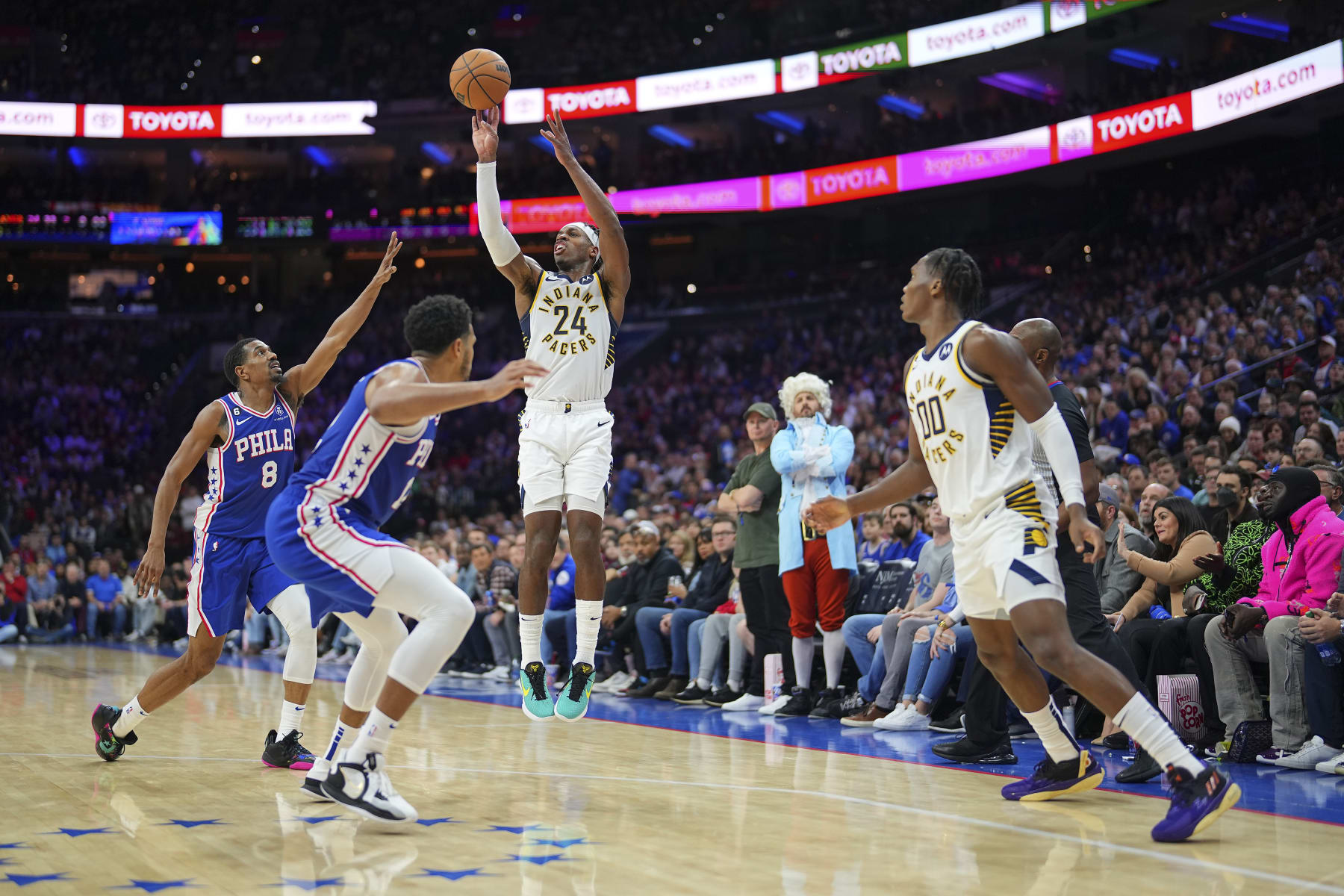
Pacers: A
Let’s be clear about one thing: McDermott does not replace Buddy Hield’s functional gravity. He does, however, remain a malleable offensive weapon.
McDermott will supplement some of the outside efficiency and volume forfeited with Hield’s departure—depending on how much he plays. The 32-year-old is canning 43.5 percent of his spot-up triples.
Getting by with Hield as the pseudo 2 or 3 is a luxury Indiana may not have with McDermott. Never mind the defensive concerns. Neither should be guarding true wings. Hield is more of a knife-through-butter moving on- and off-ball at the other end.
To McDermott’s credit, though, he has the footwork and size to slip through defensive crevices himself. And there is more range to his offensive package than strictly beyond-the-arc shooting. The Pacers have the spacing to utilize him on cuts, and he’s shown in the past that he can impactful in those situations. This is a worthwhile stopgap for a team straddling multiple (if not warring) agendas.
Spurs: A-
Congratulations to the Spurs on finally getting Morris. Their union will be short-lived. San Antonio plans to buy him out, according to Shams Charania of The Athletic and Stadium. But at least this time his acquisition is official.
This is mostly “nothing to see here” energy from the Spurs. They moved a 32-year-old who wasn’t playing all that much for second-round equity—the exact type of transaction teams in their situation should prioritize.
(Editor’s note: This deal might get looped into the Hield-to-the-Sixers trade from earlier Thursday.)
The Trade
Milwaukee Bucks Receive: Patrick Beverley
Philadelphia 76ers Receive: Cameron Payne, 2027 second-round pick
Grades
Bucks: B
We tend to over-romanticize distant second-round picks, but Milwaukee has so few movable assets that everything matters, including this selection. And yet, this is largely fine.
Beverley is 35 and no longer All-Defense material. But he still defends. Sometimes, the effort is in vain—purely try-hard stuff. Other times, it’s performative, chaotic energy disguised as effort.
Overall, though, he is an upgrade for the Bucks on the perimeter when it comes to guarding 1s and 2s. Even his empty-effort nights deepen an otherwise sparse reserve rotation. And if he starts taking and making more spot-up threes again, this could turn into one of those stealthy-impactful moves you actually feel in the playoffs.
Sixers: B+
Losing Beverley as an emotional bellwether stings. But the Sixers are far from getting hosed here.
What Payne lacks in defensive hustle and strength, he offsets with additional layers of offensive creation. He is shooting 53.3 percent on floaters and almost 40 percent from three, including 43.6 percent on pull-up triples. His 11-of-18 clip on step-back jumpers has the chance to be an interesting wrinkle to boot.
All of these returns come in blippy samples. That’s fine. The Sixers need offensive reinforcement to help navigate Joel Embiid’s absence. And anything they’re forfeiting defensively with Beverley they have the potential to recoup with the has-to-happen-now Kyle Lowry buyout signing.
The Trade
Brooklyn Nets Receive: Keita Bates-Diop, Jordan Goodwin, three-second picks
Memphis Grizzlies Receive: Chimezie Metu, Yuta Watanabe, pick swap
Phoenix Suns Receive: Royce O’Neale, David Roddy
Grades
Nets: B+
This is pretty good value for O’Neale when you consider he’s on an expiring contract and shouldn’t be tussling with cream-of-the-crop point-of-attack creators anymore.
Exact second-round details aren’t yet available, but Phoenix has two ultra-distant selections from Memphis. Getting even one of those is a quaint flier.
As far as the actual players go, we’ll see who actually sticks in Brooklyn. Experimenting with Bates-Diop should be a priority, particularly after moving O’Neale.
Grizzlies: TBD
Trading De’Anthony Melton for Roddy already isn’t looking so hot. It looks worse now.
Perhaps that changes once we know which pick swap Memphis is getting from Phoenix. But I doubt it.
Reuniting with Watanabe is a semi-interesting development—provided he finally uncorks more threes. Then again, even if he does, the Grizzlies won’t have the Bird rights to keep him should he play well enough to decline his player option so…yeah. Metu should play if they keep him, if only because Memphis turned over a good amount of frontcourt names in advance of the deadline.
Suns: A+
Snagging O’Neale for second-round picks and minimum contracts without including one of your two best salary-matching assets (Grayson Allen or Nassir Little) is, in no uncertain terms, a home run for the Suns.
O’Neale is a notch or two slower than he used to be and shouldn’t be guarding elite players at the point of attack. But he can still get up and make threes and rumble with opposing 2s, 3s and 4s—a body of work that gives him member-of-the-closing-unit potential.
Lament the inclusion of so many second-rounders if you must. The Suns have Devin Booker, Kevin Durant and Bradley Beal. Grabbing someone who can rank as one of their five to seven most dependable rotation players is more valuable than mystery-box picks outside the first round.
The Trade
Charlotte Hornets Receive: Seth Curry, Grant Williams, 2027 first-round pick (top-two protection)
Dallas Mavericks Receive: P.J. Washington, two second-round picks
Grades
Hornets: A
Charlotte is getting excellent value for Washington, particularly amid an uneven season in which his outside efficiency has dipped but he’s made the most of his paint touches. That Dallas selection is barely protected and postdates the contracts of both Luka Dončić (2026-27 player option) and Kyrie Irving.
Grabbing a looksy at Williams counts as something, too. He never quite found his footing on the Mavericks, but he’s a stretchy forward who can switch and play next to Mark Williams on the frontline.
Will Williams take enough threes? Complain less? Grab a defensive rebound? All fair questions. But he’s 25, and the final three years and $40.9 million on his contract aren’t back-breaking, even if they might seem dicey.
Mavericks: D+
Make no mistake, Washington is an upper-echelon fit in Dallas. He has some downhill and interior craftiness to his game, and he will knock down a higher percentage of his threes while fielding passes from Luka and Kyrie.
But!
Dating back to the sign-and-trade transaction that landed them Williams this past offseason, the Mavericks have now turned a 2027 first-rounder and an unprotected 2030 first-round swap into…P.J. Washington.
That is, uh, underwhelming.
The Trade
Brooklyn Nets Receive: Dennis Schröder and Thaddeus Young
Toronto Raptors Receive: Spencer Dinwiddie
Grades
Nets: B
Um, sure?
On the bright side, it doesn’t look like the Nets included Dennis Smith Jr. in this deal (for now, anyway). And Schröder, unlike Dinwiddie, is on the books for next season at roughly mid-level-exception money. That’s a good stopgap to have for a Brooklyn offense thin on self-creators and facilitators.
Schröder is also having a better season from deep than Dinwiddie and remains both a higher-volume and -efficiency player at the rim. So while this deal doesn’t scream “game-changer,” it’s a combination of minor needle-mover and could-be savvy bookkeeping by Brooklyn.
Raptors: B+
Toronto is prioritizing flexibility above all else with this swap.
The best version of Dinwiddie is better than Schröder as a perimeter creator, but the Raptors won’t be in the business of finding out. They plan to waive the former, per Shams Charania of The Athletic and Stadium.
Offloading the $13 million Schröder is owed next season is the bigger deal. Toronto now has the bandwidth to carry Immanuel Quickley’s restricted free agency hold and chisel out more than $40 million in cap space.
Loosely—nay, exactly—translated: The Raptors are a must-watch team over the offseason.
The Trade(s)
Dallas Mavericks Receive: 2024 first-round pick (second-least favorable from Houston, L.A. Clippers, Oklahoma City and Utah)
Oklahoma City Thunder Receive: 2028 first-round pick swap
Dallas Mavericks Receive: Daniel Gafford
Washington Wizards Receive: Richaun Holmes, draft compensation, 2024 first-round pick (second-least favorable from Houston, L.A. Clippers, Oklahoma City and Utah)
Grades
Mavericks: B-
Bringing in Gafford makes a ton of sense for the Mavs. Their reserve-big ranks are inherently thin, and Dereck Lively II’s nasal fracture has only hollowed out the frontcourt even further.
Gafford fits the bill of someone who should work well alongside Luka Dončić and Kyrie Irving. He is a reliable screener and roller and has some touch away from the basket. He’s downed 6-of-10 mid-range attempts on the season and can keep defenses on their toes by flipping up looks outside the restricted area.
Dallas’ rim protection will be better off for his arrival. Opponents are shooting under 59 percent against him at the basket, and only three players are contesting more point-blank opportunities per game overall. The $13.4 million he’s owed next season is also just a hair more than Holmes’ $12.9 million player option and reasonable backup-big money. Especially when the backup big actually plays.
Two big questions that will define this deal: Will Gafford do a better job cleaning up the defensive glass on the Mavericks than he did on the Wizards? And did Dallas get a little too reckless by now forfeiting rights to two first-round swaps (2028 and 2030) that postdate Luka’s current contract?
Thunder: A
Giving up a tangible first-round pick for a swap that you may or may not exercise is taboo for most teams. But the Thunder have officially reached a point at which their imminent inbound first-rounders exceed their roster space.
Flipping a first-rounder that could convey in the bottom five of a weak draft for a bite at the Mavs’ future beyond Luka’s current deal is an incredibly shrewd swing.
Wizards: A-
The spirit of this trade makes sense for the Wizards. They should be prioritizing draft compensation, even when it comes attached to undesirable money like Holmes’ 2024-25 player option.
And who knows, maybe Washington can rehab the value of Richaun “Used To Be A Master Of The Floater” Holmes?
Regardless, bagging an extra first-rounder without hamstringing the team’s cap sheet beyond 2024-25 is quality stuff from Washington’s front office.
The Trade
Detroit Pistons Receive: Ryan Arcidiacono, Malachi Flynn, Evan Fournier, Quentin Grimes, two second-round picks
New York Knicks Receive: Bojan Bogdanović and Alec Burks
(*Note: This move is likely getting broken up into multiple transactions, but we’ll be grading it as one.)
Pistons: B+
Getting the final details of this trade was a journey. But we’re finally here. And, well, the Pistons finally did it! They traded Bogdanović!
Detroit’s deadline is currently all over the place. But the addition of Simone Fontecchio makes far more sense following this deal.
Fournier has a team option for next season, which the Pistons will almost assuredly decline. That means they essentially flipped Bogdanović’s $20 million salary slot for a some-three-more-D prospect with one year left on his rookie scale in Grimes and draft equity.
This is rock-solid business that has the potential to mushroom into something more. Grimes has struggled to sustain three-point volume and attack-in-space aggression. He’s also flashed plenty of both. A more consistent, minutes-heavy role in Detroit should serve him well. And when his threes are falling, it will make life easier on everyone from Cade Cunningham to Jaden Ivey to Jalen Duren.
Knicks: A-
Jettisoning Immanuel Quickley and RJ Barrett for OG Anunoby created a ball-handling void on the Knicks’ roster. Julius Randle’s dislocated right shoulder then left the rotation light on even more shot creation on top of shot-making.
New York has now filled basically every one of those gaps.
Burks is not an A-plus passer. But the Knicks have plenty of ball-movers to offset the facilitation drop-off when Jalen Brunson catches a breather—mainly Josh Hart, Donte DiVincenzo and Deuce McBride. Burks is most critical for his reliable self-starting. He has some wiggle when he gets into the lane, and he’s drilling over 38 percent of his pull-up triples this season.
Bogdanović is, frankly, a monster get. He’s one of the most dangerous perimeter scorers in the league. That’s not hyperbole. His 41.5 percent clip from deep comes on more than eight attempts per 36 minutes, he’s downing nearly 50 percent of his shots off drives, and he’ll bust out the on-ball chops every now and then to jump-start his own offense.
Bogdanović should fit like a glove on the Knicks, both with and without Randle. Head coach Tom Thibodeau can stagger the two, but New York has the personnel to play Bogdanović, Randle and a big together. (“You’re welcome,” says Anunoby.) And to top it all off, the Knicks are far enough beneath the luxury tax to make a buyout splash if the opportunity presents itself.
One small concern here: The Knicks are rolling over Fournier’s salary slot into a much better player, but also an older one. Bogdanović turns 35 in April, and though guaranteeing his $19 million salary for next season will arm New York with a valuable anchor in prospective trades, his next team likely won’t treat him as an inbound asset.
Nitpicking? Beyond so. This is a really good deal for the Knicks—one that serves immediate and long-haul agendas.
The Trade
Toronto Raptors Receive: Ochai Agbaji, Kelly Olynyk
Utah Jazz Receive: Kira Lewis Jr., Otto Porter Jr., 2024 first-round pick (least favorable from Houston, L.A. Clippers, Oklahoma City and Utah)
Grades
Raptors: B+
Most won’t love the not-very-good Raptors forking over a first-round pick. Get over it. That selection is slated to convey in the bottom five, and nobody seems to love this draft class. Toronto also currently has Indiana’s first-rounder as well as the No. 31 pick anyway.
On top of that, the Raptors must grapple with the reality of their 2024 first-rounder being owed to San Antonio (top-six protection). This trade increases the likelihood of that pick conveying, which would allow Toronto to plan its bigger picture with more flexibility.
Both Agbaji and Olynyk fill needs, too.
Agbaji is having a sophomore campaign to forget. But he has provided glimpses into functional spacing and finishing and try-hard defense. If nothing else, he gives a still-shooting-starved Toronto roster some optionality depth on the perimeter.
Olynyk is having a terrific season in which he’s stretching defenses and, most impressively, facilitating the offense from live-dribbles and standstills. He will be a boon both for the Raptors’ transition machine and half-court attack.
If things don’t work out, Olynyk is a free agent this summer. So at worst, this is a zero-risk deal. But at best, Toronto just added a big with standout versatility (and Canadian roots) to keep longer term—a scenario that must be top priority after giving up a first to get him.
Jazz: C-
It says a lot about the Jazz’s view of Agbaji that this is the return they accepted while also sending out one of their most immediately valuable players. Team CEO Danny Ainge and general manager Justin Zanik deserve credit for pulling the ripcord when other organizations might have tried to force fit and development that never materialized—a decision perhaps made easier since they weren’t the ones who drafted Agbaji. (He came over from Cleveland in the Donovan Mitchell trade.)
The Jazz also didn’t have a first-rounder in this year’s draft…technically speaking. They owe their pick to Oklahoma City with top-10 protection. They have been frisky enough for that pick to convey this year, so guaranteeing themselves a first-rounder has purpose.
At the same time, this move in tandem with Simone Fontecchio’s departure makes it far more likely that Utah slumps out of the play-in race and retains its own pick. And it scooped up a top-35 selection as part of the Fontecchio trade. Is there that big of a difference between, say, No. 27 and No. 33 in this class?
This says nothing of the value Olynyk brought to the court. Yes, at 31 and approaching free agency, he doesn’t fit their timeline. And his exit should pave the way for more Taylor Hendricks minutes. But for this return, the Jazz would have been better off seeing this season through as currently constructed, good vibes and all.
The Trade
Charlotte Hornets Receive: Dāvis Bertāns, Tre Mann, Vasilije Micić, draft compensation
Oklahoma City Thunder Receive: Gordon Hayward
Grades
Hornets: B+
Loving this deal for the Hornets is impossible. Understanding it is easy.
Hayward is 33, headed to free agency and injury-prone. He didn’t factor into Charlotte’s future. (This deal also shaves more than $3 million off the team’s 2023-24 payroll. I will never stan for saving team governors money, but the bookkeeping here has additional implications.
Chief among them: The Hornets are actively considering—or outright entering—a more gradual reset. Moving Terry Rozier proved as much. This solidifies it.
Getting a look at Mann for the rest of this year is no small shakes, either. LaMelo Ball is coping with another ankle injury, and Mann has some real on-ball squishiness to his game.
Micić, meanwhile, is more than a throw-in. He has galvanized some punchy Thunder bench units. Charlotte gets someone who injects off-ball movement, shooting and secondary creation—all of which are needs when LaMelo’s injured and Rozier’s in Miami. At age 30, Micić doesn’t align with the Hornets’ window, but cheaply compensated floor-spacers who don’t monopolize possessions can help streamline development and/or buyout future trade packages.
Thunder: A-
Oklahoma City just bought at the trade deadline. This is not a drill. It actually happened.
Granted, this isn’t a caps-lock BUY. It could amount to a rental. But Hayward, who hasn’t played since Dec. 26 while dealing with a left calf strain, has enough on-ball jiggle left in him to fortify the Thunder’s playoff offense.
Frankly, he might even close some important games over Lu Dort or Josh Giddey. Defenders cannot roam off him the same way they can the former two. Hayward will do much more in best-of-seven and crunch-time circumstances to open up the floor for Shai Gilgeous-Alexander and Jalen Williams.
Landing his Bird rights is useful as well. The Thunder will have first licks at keeping him, and he’s due for a pay cut from his $31.5 million salary that’s sizable enough for him to be viewed as a Human Trade Exception on his next deal. Including Micić is a risk. He’s played some meaningful minutes. But the Thunder have Isaiah Joe to bend defenses, and a healthy Hayward nudges their immediate ceiling higher.
The Trade
Indiana Pacers Receive: Furkan Korkmaz, Marcus Morris Sr., Toronto’s 2024 second-round pick, Portland’s 2029 second-round pick, L.A. Clippers’ 2029 second-round pick
Philadelphia 76ers Receive: Buddy Hield
Grades
Sixers: A+
Bleacher Report’s own Bryan Toporek expertly outlayed the on-court impact of this deal for the Sixers:
Even better, this move also signals the Sixers aren’t waving the white flag on this season. That suggests Joel Embiid could return from his don’t-call-it-a-surgery left knee procedure by the time the playoffs roll around.
Am I galaxy-braining this? Maybe. But I checked the Trade Grade Rules. This type of logic is allowed.
Better and better still, the Sixers juiced up their immediate flexibility without compromising their vaunted (perhaps overrated) cap-space plan this summer. They are now $2.7 million below the tax, per ESPN’s Bobby Marks, which frees them up for more activity on the buyout market. And while they’ll surely look to re-sign Hield, his expiring contract aligns with their capacity to carve out around $55-60 million in spending power over the offseason.
Surrendering three could-be good second-round picks isn’t nothing. But the Sixers’ timeline is now, and three could-be-good seconds is a more-than-reasonable price to pay for one of the league’s highest-gravity floor-spacers.
Pacers: C-
Rationalizing this deal through the Pacers’ lens isn’t that difficult. Hield is entering free agency and have left for nothing this summer. Bennedict Mathurin, Andrew Nembhard and Ben Sheppard are on the roster. A Hield-Tyrese Haliburton duo is rough defensively. And Indy bags a potential top-40 pick after shipping out its own first-rounder this year in the Pascal Siakam trade.
With all of that in mind: Eh.
Indiana’s is going to miss the magnetizing pull that Hield had on defenses beyond the arc, away from the ball and when going downhill. This move infers a commitment to the bigger picture, an enviable line of thinking post-Siakam trade. Then again: They just traded for Siakam! The here and now is part of the bigger picture.
Maybe this says something about the organization’s faith in Hali’s left hamstring holding up. Maybe Hield didn’t want to be in Indy long-term. Maybe the Pacers didn’t plan to keep him in Indy, either. Whatever the case, this trade is justifiable, but it’s not something to love.
The Trade
Detroit Pistons Receive: Simone Fontecchio
Utah Jazz Receive: Kevin Knox, draft rights to Gabriele Procida, 2024 second-round pick (more favorable of Memphis or Washington)
Grades
Pistons: C-
Jazz: B+
The Trade
Boston Celtics Receive: Xavier Tillman
Memphis Grizzlies Receive: Lamar Stevens, Atlanta’s 2027 second-round pick, Dallas’ 2030 second-round pick
Grades
Celtics: A-
Grizzlies: B+
The Trade
Detroit Pistons Receive: Troy Brown Jr., Shake Milton, 2030 second-round pick
Minnesota Timberwolves Receive: Monte Morris
Grades
Pistons: B+
Timberwolves: B+
The Trade
Detroit Pistons Receive: Danuel House Jr., New York’s 2024 second-round pick, cash
Philadelphia 76ers Receive: 2028 second-round pick (top-55 protection)
Grades
Pistons: B+
Sixers: B+
The Trade
Milwaukee Bucks Receive: Cash
Sacramento Kings Receive: Robin Lopez (to be waived)
Grades
Bucks: TBD
Kings: TBD
The Trade
Golden State Warriors Receive: Second-round pick
Indiana Pacers Receive: Cory Joseph, cash
Grades
Warriors: C
Pacers: B
The Trade
Boston Celtics Receive: Second-round pick (top-55 protection)
Portland Trail Blazers: Dalano Banton
Grades
Celtics: B
Blazers: B
The Trade
Boston Celtics Receive: Jaden Springer
Philadelphia 76ers Receive: Second-round pick
Grades
Celtics: B+
Sixers: B-
Dan Favale covers the NBA for Bleacher Report. Follow him on Twitter (@danfavale), and subscribe to the Hardwood Knocks podcast, co-hosted by Bleacher Report’s Grant Hughes.
Unless otherwise noted, stats courtesy of NBA.com, Basketball Reference, Stathead or Cleaning the Glass. Salary information via Spotrac. Draft-pick obligations via RealGM.
