


The ability to renew your passport or driver's license, pay taxes, and access government data anytime, anywhere with the click of a button or swipe of a screen is a new feature designed to help prevent the spread of COVID-19. This has become even more important during the viral pandemic. virus. Beyond the obvious efficiency and transparency gains that digital government services provide, “e-government” can actually make economies more attractive to foreign investors.
A recent IMF staff study linked for the first time the ease of accessing government information and services online to the amount of foreign direct investment a country receives. For many countries, this positive impact is likely to become even stronger as the pandemic forces governments to provide more services and information online.
Examining foreign direct investment inflows in 178 host countries over approximately 16 years, we find that the presence of e-government services appears to stimulate foreign direct investment inflows. Specifically, we find that countries that implement and adopt strong information and communication technologies, regardless of their level of development, attract more inflows compared to countries with weaker internet access. As this week's chart shows, it is clear that there is a positive relationship between e-government and foreign direct investment.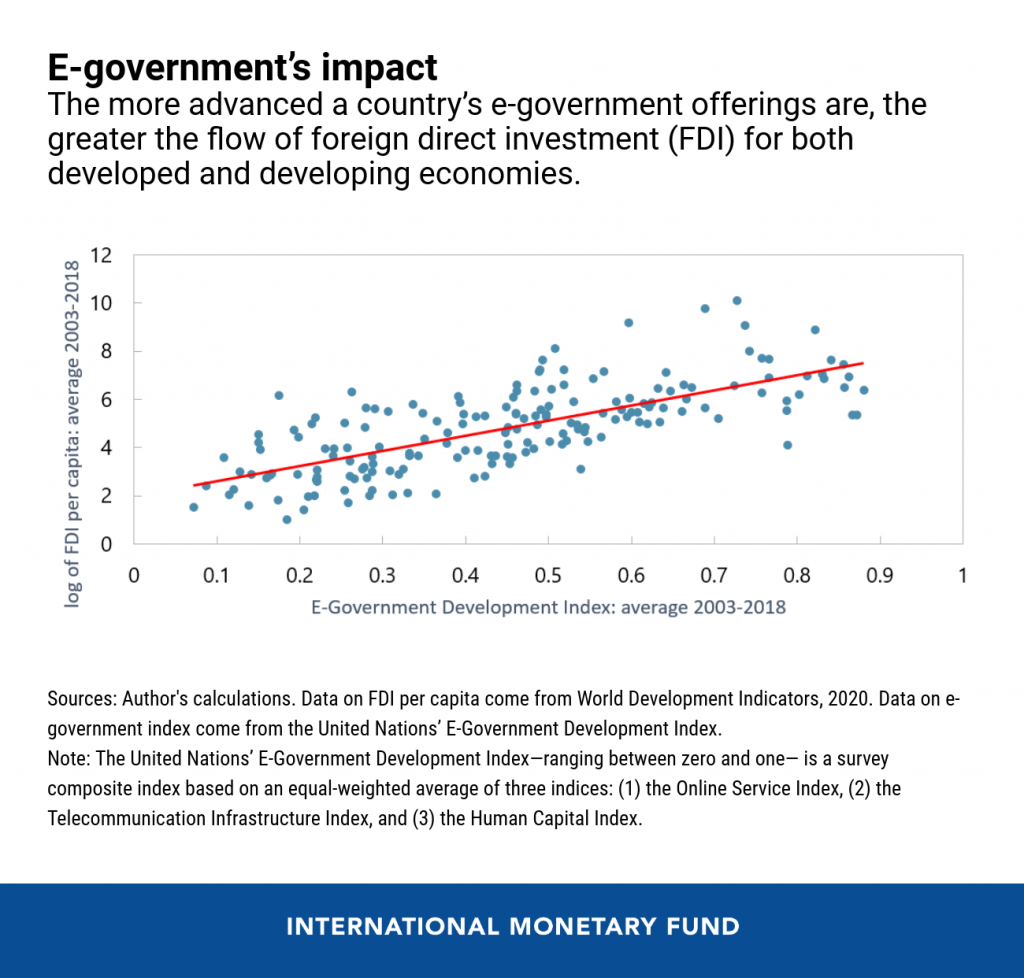
The findings also highlight yet another potential juncture: the still-huge global digital divide and the technology gap between high- and low-income countries. Many people around the world still do not have access to the internet. According to the 2020 United Nations e-Government Development Index, about half of the 193 countries covered are below the global average of 0.60, while African countries' average index score is almost a third lower than the index average. Denmark, South Korea and Estonia are world leaders in providing e-government services and electronic distribution of information. Still, many developing countries such as Bhutan, Bangladesh, and Cambodia have become leaders in the development of e-government infrastructure. These countries advanced from the middle group of the index in 2020 to become some of the highest ranked developing countries.
This study suggests that countries should focus on developing e-government services as part of their strategies to attract more foreign direct investment. However, to reduce the gap between high- and low-income economies and provide digital services to all, governments must drive improvements in information and communication technology infrastructure. This is a critical component for effective e-government services. In parallel, governments should strive to make the internet accessible, affordable and secure for all.
