

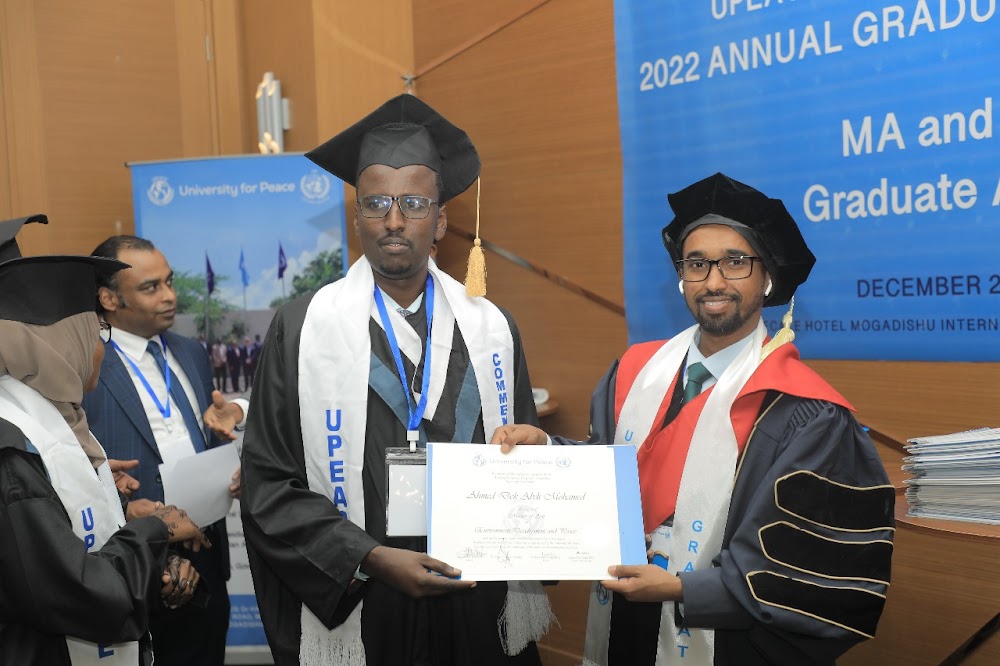
The theme of this year's World Education Day is “Learning for Lasting Peace.”
Nowhere in Africa or around the world is this theme more relevant than in Somalia, which is slowly recovering from decades of civil war, political anarchy, and violent extremism.
However, gradual but steady progress has been made towards achieving peace in Somalia, and the education sector, particularly higher education, is one area that has benefited from this progress.
As a driving force behind the establishment of the United Nations University for Peace in Somalia (UPEACE), I reflect on the inspiring journey that ultimately led President Hassan Sheikh Mohamud to graduate with a Ph.D. In 2022, he will become the first head of state in Somalia's history to hold a Ph.D.
My early fascination with the complex interplay of peace and conflict deeply shaped my educational and professional trajectory.
After graduating with a degree in economics from the University of Mogadishu in 2009, I further studied economic policy and economic planning at Makerere University.
The curriculum was not just about numbers and policy. It was a journey into the heart of social change, addressing poverty, unemployment and, above all, the foundations of peace and stability.
I live in Uganda, which is slowly healing from the scars of civil war.
I was drawn to the stories of the people who lived there and their youthful energy.
This curiosity led me to pursue a master's degree in conflict resolution and peacebuilding.
This program expanded my understanding of peace beyond textbooks and examined the roots of conflict and the delicate balance that maintains peace.
Here I recognized the major factors destroying peace: political repression, armed conflict, the devastating effects of climate change, and the dire scarcity of resources.
As a native of Somalia, which has experienced repeated droughts, the lessons weren't just academic, they were personal.
I have witnessed firsthand the devastating effects of the environmental crisis, not only in Somalia but across the Horn of Africa.
Mass evacuations and limited educational opportunities – these were not just news headlines. They were a chapter in my life as a refugee in Uganda.
My academic path then intersected with the Resilient Africa Network (RAN) at the School of Public Health.
The initiative, funded by USAID and jointly conceived by more than 16 African universities, was a melting pot of innovation to strengthen the resilience of local communities.
My involvement with RAN has shifted my focus to a niche but important field: environmental economics intertwined with peace.
This journey led me to a fellowship at Makerere University in partnership with Tulane University, supported by the Gates Foundation.
This program, which focuses on disaster leadership, is about more than just learning. It was about doing.
I was at the center of cyclone relief efforts in Somalia's Puntland state, gaining valuable experience in crisis leadership.
These experiences helped establish the Sadar Institute for Development and Resilience and shaped its collaborations with various international organizations and universities.
In 2014, my journey took a major turn toward strengthening climate resilience through peace governance and development research.
In seminars on disaster management leadership, I have consistently advocated for building a peace university in Somalia, drawing on community insights and academic backgrounds.
We found that disaster resilience research and education is complex, but expertise from both international and national organizations is urgently needed.
An important milestone was meeting Professor Samuel Kale in 2018.
Our conversations, rich in philosophical and scientific insight, motivated me to pursue a Ph.D., despite my extensive efforts.
His guidance was instrumental in my journey and guided me through my Ph.D.
The program started in September 2018.
During this time, I worked hard on research and greatly contributed to the sustainability of the university in a time of financial difficulties.
The decision to move the university to Somalia was monumental.
We weighed the risks given our membership in the United Nations and our staff safety obligations.
Establishing it within Mogadishu's green belt was a strategic move.
The opening ceremony was a testament to our efforts, with over 500 participants and 800 applications received.
We have introduced master's and doctoral programs focused on peace governance, human rights, and environmental peace.
The response has been overwhelming and our experienced students have enriched our academic environment.
It is noteworthy that former President Hassan Sheikh Mahmoud (2012-2017) was re-elected in May 2022, and students will enroll in 2022 and graduate with a Ph.D., demonstrating the transformative power of education. This was emphasized.
Our expansion continues thanks to the generous Qatar Charitable Foundation with 33 doctoral scholarships, complemented by seven University of Peace scholarship programs including Leadership, Sustainable Development, Desert Blue Economy and Maritime Security. I did.
The University's growth is a beacon of the transformative power of education and the impact of dedicated individuals.
Our journey at Peace University was not without its challenges.
We had to adapt our teaching methods to a practical, hands-on online format and address security concerns that are often amplified by media coverage.
But our dedication to developing peace leaders meant tackling these challenges head-on.
During negotiations to establish a university in Somalia, I passionately advocated the need for it, emphasizing that “If a university for peace is to be located anywhere, it must be in Somalia.''
This was a pivotal moment that aligned our leadership team with our mission.
Today, the Somalia Program is a cornerstone of the university and contributes significantly to research and training in peace, conflict and security.
Despite the conflict, we have demonstrated that Somalia has a functioning governance system that includes tribal, communal, civilian, and academic sectors. All of these are important.
To rebuild the state. These sectors produce leaders who are now of vital importance in national governance. Peace University's impact extends far beyond the campus.
I am a Ph.D. It focuses on political economy and young people's involvement in politics.
We have experienced increased demand for our programs, highlighting the need for continued support and education.
Our progress is due to the resilience of our students, the dedication of our instructors and staff, and the unwavering support of our Africa Regional Program Headquarters in Addis Ababa.
People like Samuel Kale and leaders like Professor Francisco Rojas and Vice President Juan Carlo, who graced Somalia's first graduation ceremony, have been the pillars of our success.
Peace University's comprehensive approach to understanding society, economics, and ecology sets new standards for educational institutions worldwide.
Initiatives like the Presidential Scholarship, supported by Qatar Charities, are expanding higher education in Somalia and fostering continued research and development.
Our commitment to Somalia and promoting lasting peace is unwavering.
Our journey to educate and inspire the next generation of leaders continues to be a testament to the power of education in transforming society and building a more peaceful world. thank you.
Dr. Mohamed Osman is UPEACE University's sub-regional representative for the Middle East, East and Southern Africa in the Africa Regional Programme.
