

A deep dive into Omowumi Olabode Stephen Ekundayo's insightful lecture on the educational landscape in Nigeria reveals that if education is not effectively addressing today's challenges, how can it leave us with tomorrow's uncertainties? I realized that I was faced with the pressing question of whether I could prepare myself for sex.
Dr. Ekundayo highlighted Nigeria’s adoption of the 6-3-3-4 education model, which was originally successful in countries such as China, Germany and Ghana. However, despite noble intentions, Nigeria has struggled to fully implement this model. The results are clear. Millions of Nigerian children remain out of school or receive substandard education, perpetuating cycles of poverty and inequality.
“Nigeria's education system is mired in various crises, including crumbling infrastructure, neglect, wasted resources, and a poor service environment,” he said.
Where education once prioritized survival skills, today it demands adaptability, critical thinking and innovation.
These problems are not limited to Nigeria. They reverberate around the world, manifesting themselves in economic instability, educational inequality, and social division. Despite impressive advances in technology and education, fundamental problems remain. The question arises: What is the true purpose of education in today's world?
Looking back at the evolution of education from early hunter-gatherer societies to modern times highlights the changing needs of society. Where education once prioritized survival skills, today it demands adaptability, critical thinking, and innovation.
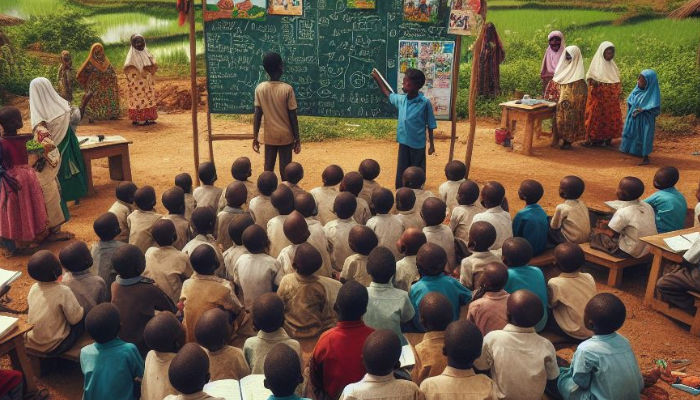
Consider the case of Adama Ramina, a young girl living in a rural village in Nigeria. Despite her eagerness to learn, she faces many barriers to her education, including her crowded classroom, her outdated curriculum, and a lack of resources. Adama's story is emblematic of the systemic challenges plaguing Nigeria's education system and hindering the potential of millions of children.
Also read: An ally in the classroom: How edtech can support schools and teachers
Moreover, economic disparities exacerbate educational inequalities and perpetuate the cycle of poverty. In Nigeria, as in many other countries, the gap between rich and poor continues to widen, with stagnant wages and concentrated wealth hindering social mobility. This disparity is not just economic. It is systemic and affects access to quality education and opportunities for advancement.
Consider the contrasting experiences of two students. Tunde Ben White, born into a wealthy family with access to a top-notch education, and Adama, whose family struggles to make ends meet. While Tunde is thriving with well-equipped classrooms with dedicated teachers, Adama is grappling with overcrowded schools and outdated textbooks. Cycles of inequality are perpetuated, highlighting the urgent need for systemic change.
As we face these challenges, we need to reevaluate the purpose of education. Education needs to go beyond just imparting knowledge to fostering critical thinking, empathy, and social responsibility. We need to enable students to challenge social norms, confront injustice, and bring about positive change.
Imagine a classroom where students consider real-world problems, engage in meaningful dialogue, and collaborate on solutions. Imagine a curriculum that transcends traditional boundaries and integrates interdisciplinary learning and practical skills. This is the vision of education that we should strive for. It prepares students not only for employment, but for life outside the four walls of the classroom.
Also read: Children out of school: Nigeria needs 907,769 classrooms as meeting places – UBEC
With technological advances and social changes, the role of educators has become paramount. They are more than just teachers, they are mentors, mentors, and advocates for change. Take the example of Mr. Oluwole Fehintola Atinuke, a dedicated teacher at the Lagos State College of Nursing, Ijanikin. She goes above and beyond to support her students. Through her innovative teaching methods and tutoring, she inspires her students to dream big and pursue their passions.
Let's look ahead to 2024 and envision a future where education becomes a catalyst for social change. Help students challenge the status quo, disrupt outdated systems, and build a more just and equitable world.
From my perspective, let's listen to Dr. Ekundayo's words and work to reimagine our education system in a way that fosters creativity, fosters empathy, and allows all students to reach their full potential. I would like to say Together, we can overcome tomorrow's uncertainties and redefine education for a changing world.


